
IBJJF Rule Changes 2027: What Changes for Kids and Adults
By Gracie Barra Davenport
The International Brazilian Jiu-Jitsu Federation (IBJJF) has announced a set of updates to its competition rules. According to the IBJJF, all of the changes take effect on January 1, 2027. Below is a plain-English summary of each change, split into what matters for kids and juveniles and what matters for adults and masters. Each item links to the IBJJF's official rule-changes page, which has the exact old and new wording and example videos.
This is a summary, not the rulebook. If anything here differs from the IBJJF, the official text wins. The full list is at ibjjf.com/rule-changes-2027.
The Short Version
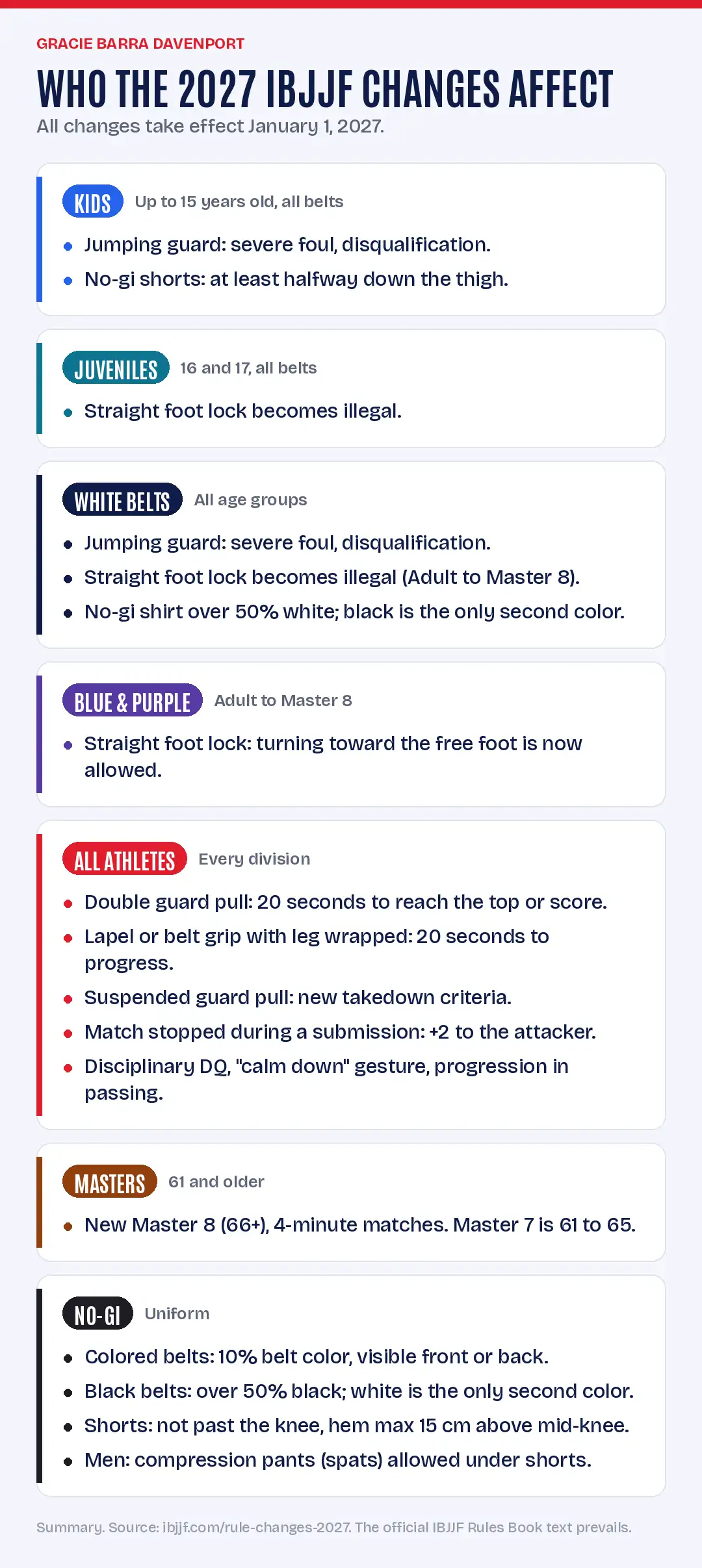
- Jumping guard becomes a disqualification (not just a restart) for kids up to 15 and for white belts of every age.
- The straight foot lock becomes illegal for white belts and for juveniles (16 and 17).
- Blue and purple belts may now turn toward the free foot when finishing a straight foot lock.
- New stalling rules for double guard pulls and for lapel or belt grips with the leg wrapped.
- No-gi uniform updates, and a new Master 8 division for athletes 66 and older.
All 13 Changes at a Glance
| # | Change | Rule |
|---|---|---|
| 1 | Jumping to closed guard becomes a severe foul (disqualification)Who: Up to 15 years (all belts); white belts of all ages | 6.2.3 M |
| 2 | Straight foot lock: turning toward the free foot is now allowedWho: Blue and purple belts, Adult to Master 8 | 6.2.3 N |
| 3 | Straight foot lock becomes illegalWho: Juveniles 16 and 17 (all belts); white belts, Adult to Master 8 | 6.2.3 N |
| 4 | Takedown vs. a suspended closed-guard pull: opponent must land on back, side or seated (3-second limit removed)Who: All athletes | 4.1.12 |
| 5 | Double guard pull: after 20 seconds, penalty to both and a standing restartWho: All athletes | 6.2.1 C |
| 6 | Lapel or belt grip with leg wrapped: 20 seconds to progress (new)Who: All athletes | 6.2.1 G |
| 7 | Disciplinary disqualification (new)Who: All athletes | 6.1.7, 6.1.8 |
| 8 | New “calm down” referee gestureWho: All athletes | Art. 1 |
| 9 | Match stopped with a submission in place: standing restart, 2 points to the attacker (new)Who: All athletes | 1.3.7 |
| 10 | Progression concept now applied to guard passingWho: All athletes | No text change |
| 11 | No-gi shirt colors by rank, white-belt shirt rule and shorts lengthWho: No-gi athletes (white-belt rule: all ages) | 8.1.16 |
| 12 | New Master 8 division (66+), 4-minute matches; Master 7 becomes 61 to 65Who: Athletes 61 and older | 1.3 |
| 13 | Compression pants (spats) allowed under no-gi shortsWho: Men, no-gi | 8.1.16 |
Source for every row: IBJJF Rule Changes 2027.
What Changes for Kids and Juveniles
Jumping guard is now a severe foul (divisions up to 15)
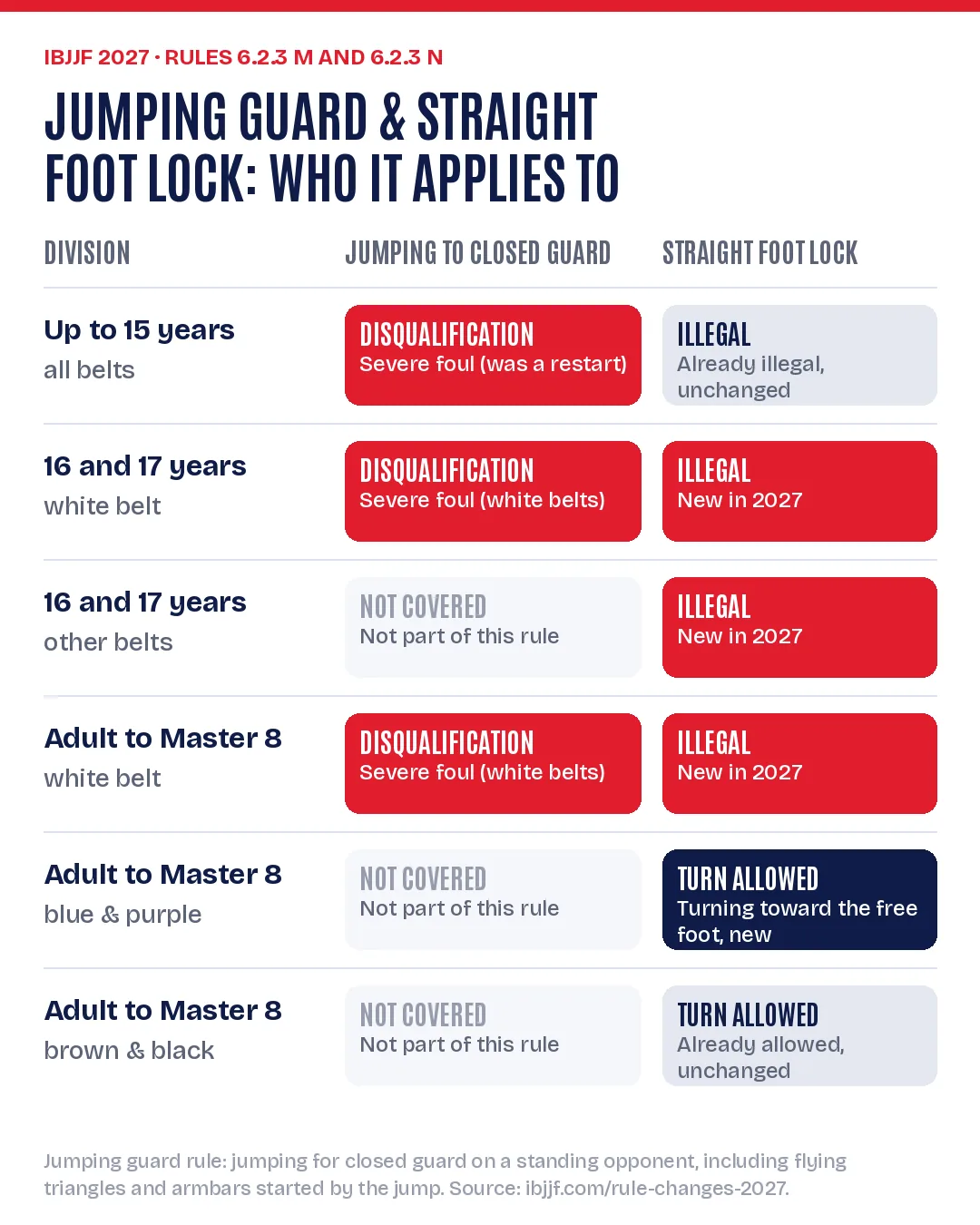
Under the current rules (Rules Book v6.1), if a child jumped to closed guard on a standing opponent, the referee simply stood both athletes back up. Starting in 2027, jumping to closed guard on a standing opponent, including flying triangles and flying armbars started from a jump, is a severe foul with disqualification from the match. This applies to all belts in divisions up to 15 years old. (Source: IBJJF, rule 6.2.3 M)
Straight foot lock becomes illegal for juveniles (16 and 17)
The straight foot lock was already illegal in the 4 to 12 and 13 to 15 year-old divisions. In 2027 it also becomes illegal for juveniles aged 16 and 17, at every belt. (Source: IBJJF, rule 6.2.3 N, illegal moves table)
Kids no-gi shorts
For kids divisions in no-gi, shorts must cover at least halfway down the thigh. The white-belt shirt rule below also applies to white belts in every age division. (Source: IBJJF, rule 8.1.16)
Parents: our BJJ belt order guide covers the kids belts and when teens move to adult belts, which affects which rules apply.
What Changes for Adults and Masters
White belts: jumping guard and straight foot locks
The jumping guard disqualification above also applies to white belts in all age groups. And the straight foot lock becomes illegal for white belts from Adult to Master 8. White belts who have been drilling a straight ankle lock for competition will need a different plan in 2027. (Source: IBJJF, rule 6.2.3 M and 6.2.3 N)
Blue and purple belts: turning in the straight foot lock
Turning in the direction of the foot that is not being attacked during a straight foot lock is no longer illegal for blue and purple belts (Adult to Master 8). Brown and black belts were already allowed to do it. Athletes who cannot use the straight foot lock at all still cannot use it, with or without the turn. (Source: IBJJF, rule 6.2.3 N, illegal moves table)
Double guard pull: 20 seconds, then a restart
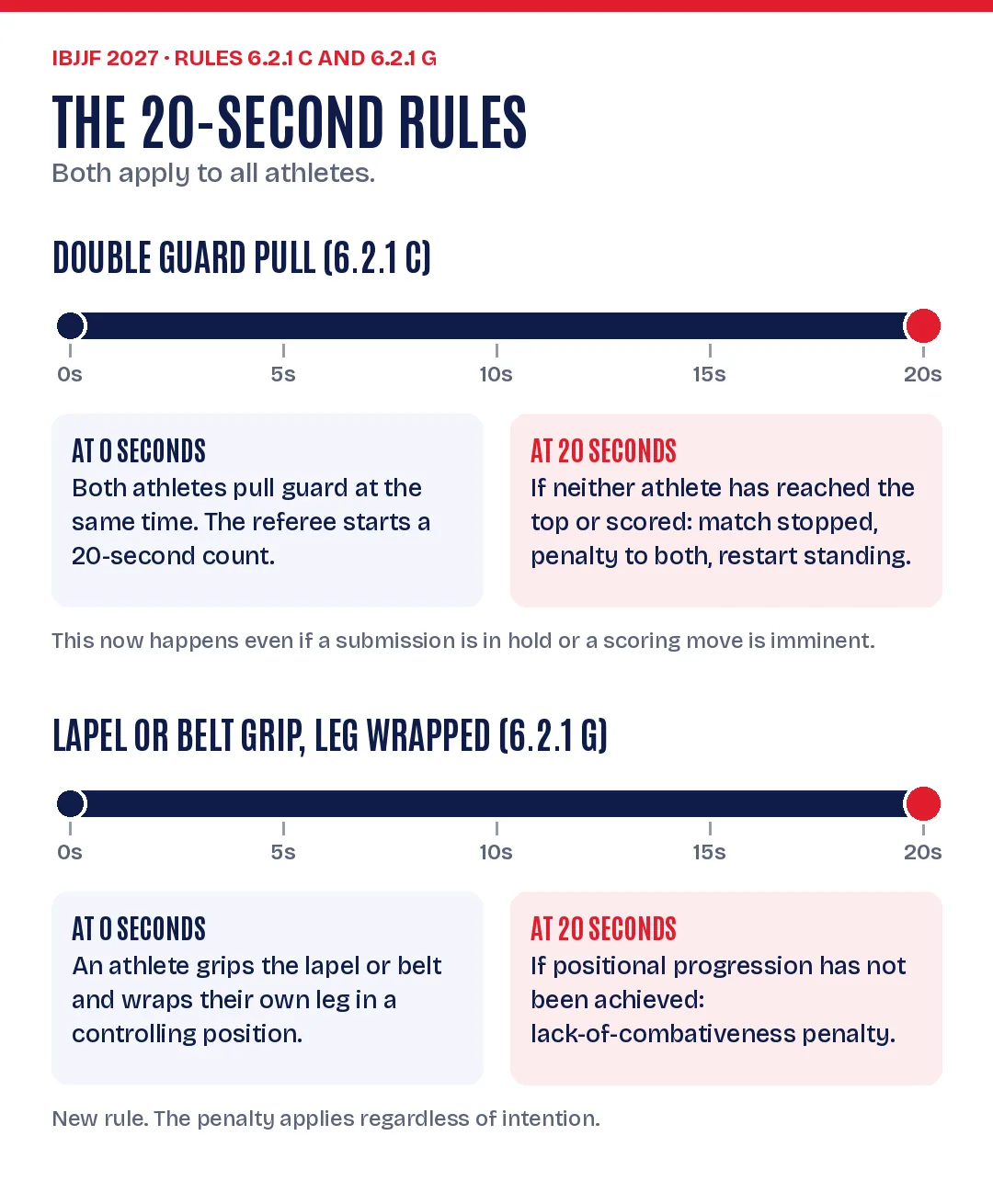
When both athletes pull guard at the same time, the referee starts a 20-second count. If neither athlete has reached the top or scored by the end of the count, the referee stops the match, penalizes both athletes and restarts them standing. That now happens even if a submission is in hold or a scoring move is about to happen. (Source: IBJJF, rule 6.2.1 C)
Lapel or belt grip with the leg wrapped: progress in 20 seconds
This is a new rule. If you grip your opponent's lapel or belt and wrap your own leg in a controlling position, you have 20 seconds to progress. If you have not, you get a lack-of-combativeness penalty, regardless of intention. (Source: IBJJF, rule 6.2.1 G)
Takedown when the opponent pulls guard and stays suspended
If you are holding the pants and your opponent pulls closed guard and stays hanging in the air, you now earn the takedown by making them land on their back, sideways or seated. The old 3-second limit to bring them down is removed. You still need to stabilize the top position for 3 seconds. (Source: IBJJF, rule 4.1.12)
Progression concept now applies to guard passing
The IBJJF says the "progression" concept it already uses when scoring sweeps is now also applied to guard passing. This one does not change the Rules Book text; the IBJJF page shows example videos. (Source: IBJJF, rule progression concept)
No-gi uniform updates
- White belts: a predominantly white shirt (more than 50%), with black as the only secondary color.
- Grey through brown belts: a black, white or black-and-white shirt with at least 10% of your belt color, visible from the front or the back, or a shirt that is 100% your belt color.
- Black belts: a predominantly black shirt (more than 50%), with white as the only secondary color (a small red area is tolerated).
- Shorts: no longer than the knee, with the hem no more than 15 cm above the middle of the knee.
- Men: compression pants (spats) and/or compression shorts are now allowed under the shorts, in black, white, black and white, and/or your belt color.
Sources: IBJJF, rule 8.1.16. If you are new to no-gi, see our post on gi vs no-gi BJJ.
New Master 8 division (66 and older)
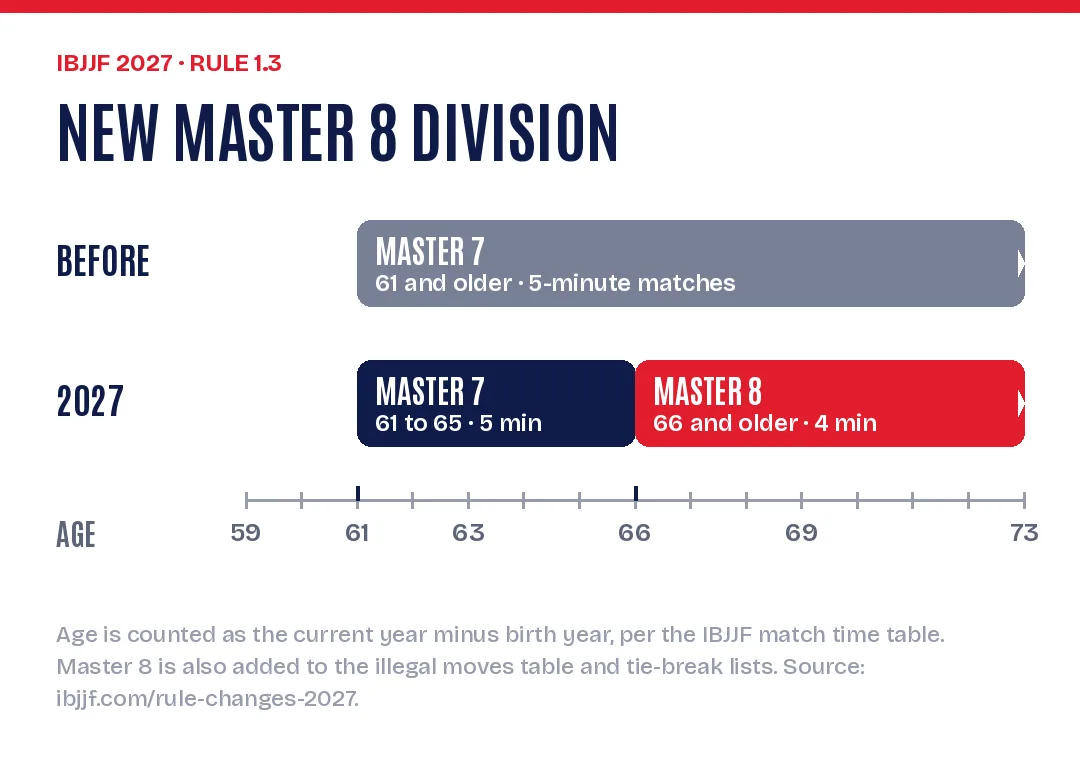
The IBJJF is adding a Master 8 division for athletes 66 and older, with 4-minute matches. Master 7 becomes ages 61 to 65. (Source: IBJJF, rule 1.3)
Other Changes for Everyone
- Disciplinary disqualification: the IBJJF may turn a severe foul into a disciplinary disqualification when it is done on purpose, or when an athlete knowingly risks injuring the opponent, including with disproportionate force. Any action meant to injure an opponent can also lead to one, even if it is not on the severe-foul list. These decisions are at the IBJJF's discretion and must be requested by the event's Referee Coordinator. (Source: IBJJF, rule 6.1.7 and 6.1.8)
- Match stopped during a submission: if a match is interrupted while a submission hold is in place, for reasons that are not either athlete's fault, and the Rules Book has no specific procedure, the match restarts standing in the center and the athlete applying the submission gets 2 points. (Source: IBJJF, rule 1.3.7)
- New "calm down" referee gesture: hands raised in front of the body with palms facing forward, then arms lowered and extended with palms down. (Source: IBJJF, rule Article 1, referee gestures)
If You Compete from Gracie Barra Davenport
Some of our students, kids and adults, enjoy testing their jiu-jitsu at tournaments, and many more never compete at all. Both are completely fine. If you are planning to compete in an IBJJF event in 2027, the practical steps are simple: read the official changes, ask your instructor after class how they affect your game, and adjust what you drill. White belts and teens who relied on a straight foot lock, and kids who like to jump guard, are the ones most affected.
We train the same Gracie Barra curriculum in our kids jiu-jitsu program and our teens and adults BJJ classes, with a focus on solid fundamentals that hold up under any ruleset. Gracie Barra was founded by Master Carlos Gracie Jr., son of Carlos Gracie, the creator of Brazilian Jiu-Jitsu.
Frequently Asked Questions
Train and Prepare with Us
Whether you want to compete in 2027 or just train, come see a class. Our free academy tour is watch-only: meet the team and watch from the side of the mat, with no pressure and nothing to sign. We are at 6250 Grandview Pkwy, Davenport, FL 33837. You can also compare membership options, with no long-term contract. Questions? Call (407) 289-0076.
Book a free academy tour