
BJJ Belts in Order: The Complete Jiu-Jitsu Belt System
Every Brazilian Jiu-Jitsu belt rank for adults and kids — the full belt order, how long each rank takes, and how promotions actually work.
Brazilian Jiu-Jitsu has one of the most respected belt systems in all of martial arts. Unlike striking arts where a black belt can be earned in a few years, jiu-jitsu belts are genuinely hard to achieve — a BJJ black belt represents 8 to 15 years of consistent training. That's not a flaw in the system; it's the entire point.
This is the complete guide to the jiu-jitsu belt ranking system: the adult BJJ belts in order, the separate kids BJJ belt system, what each rank means, how long it takes, and how promotions work at Gracie Barra.
On this page
The Adult BJJ Belts in Order
The International Brazilian Jiu-Jitsu Federation (IBJJF) recognizes five main belt colors for adults (16 and older). This is the jiu-jitsu belt order every student follows:
- White Belt — where everyone starts
- Blue Belt — the first major milestone (typically 2–3 years)
- Purple Belt — where your personal game develops
- Brown Belt — the final stage before black
- Black Belt — mastery of the fundamentals (8–15 years)
Beyond black belt, a small number of practitioners earn the coral belt (red-and-black, 7th and 8th degree) and the red belt (9th and 10th degree) — ranks reserved for grandmasters who have shaped the art over decades.
Want the deep dive on every adult rank — including timelines, skill benchmarks, and what instructors look for at each level? Read our complete guide to the BJJ belt ranks for adults (white to black). If blue belt is your next goal, see how long it takes to earn a BJJ blue belt.
The Kids BJJ Belt Order
Children under 16 follow a separate jiu-jitsu belt system, designed to give kids more frequent milestones and keep them motivated through the inevitable plateaus of learning. The kids BJJ belt order is:
- White Belt
- Gray Belt (gray-white, gray, gray-black)
- Yellow Belt (yellow-white, yellow, yellow-black)
- Orange Belt (orange-white, orange, orange-black)
- Green Belt (green-white, green, green-black)
Each color from gray through green has three sub-ranks, which is why the kids system is often described as having 13 levels. At age 16, a student with a kids belt transitions into the adult belt system — usually receiving a white or blue belt depending on their skill.
For a full breakdown of every kids rank, age requirements, and what your child learns at each stage, read our complete guide to the kids BJJ belt system.
What Do the Stripes on a BJJ Belt Mean?
Each adult belt (except white) can hold up to four stripes, marked with white tape. Stripes track your progress within a rank — measuring technical growth, attendance, and conduct on and off the mat. Four stripes generally signal that you're being evaluated for promotion to the next belt.
Stripes aren't standardized across schools; different instructors award them on different timelines. At Gracie Barra Davenport, stripes reflect consistency, technical understanding, and behavior — but the promotion to the next belt color is the meaningful milestone.
How Belt Promotions Work at Gracie Barra
At Gracie Barra Davenport, belt promotions aren't based on a fixed test or a set timetable. Your instructor watches how you train, roll, and carry yourself. The factors that matter most:
- Consistency — showing up regularly over time
- Technical understanding — grasping positions, not just memorizing moves
- Behavior — how you treat training partners, especially lower belts
- Attitude — how you respond to being submitted, to plateaus, to hard days
- Competition (optional) — not required, but it accelerates growth
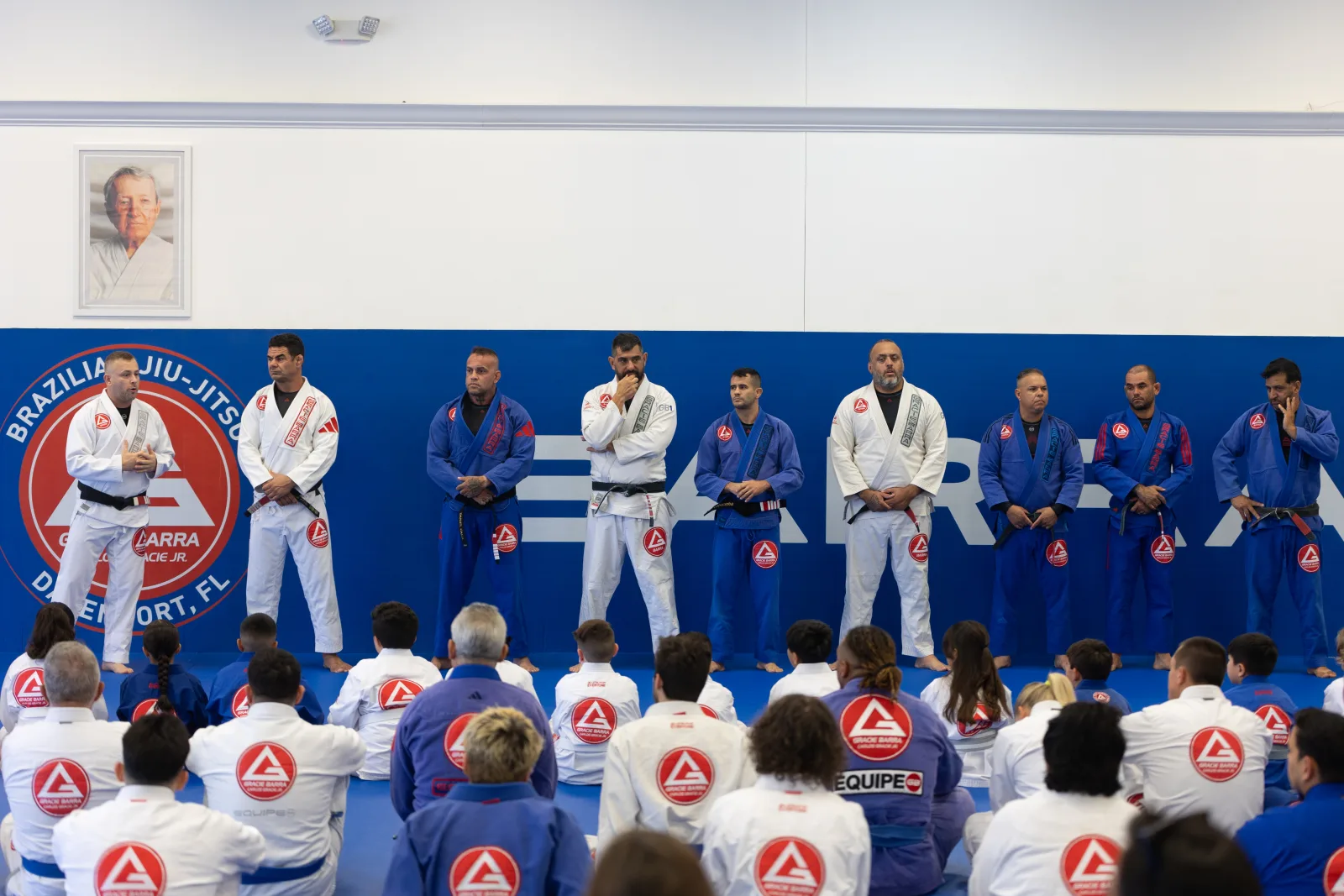
The Gracie Barra curriculum — used at 900+ schools worldwide — gives every student a clear roadmap, so you always know where you are and what you're working toward. Curious what promotion day looks like? Read about what happens at a Gracie Barra belt promotion ceremony.
How Long Does It Take to Get a Black Belt?
The honest answer: it depends on how often you train, your aptitude, your body, and a bit of luck (injuries happen). Training 3–4 times per week consistently, most people reach black belt in 10–12 years. Training 5+ times per week, some do it in 8–9. The IBJJF sets a minimum age of 19 for the black belt.
But jiu-jitsu isn't a race. The real benefits — the fitness, the problem-solving, the community, the confidence — show up at every belt level. Most long-term practitioners enjoy the journey far more than any single promotion.
Start Your Jiu-Jitsu Journey in Davenport, FL
At Gracie Barra Davenport, we welcome students at every level — from true beginners stepping on the mat for the first time to experienced grapplers looking for a high-quality training environment. Our structured GB curriculum means you'll always know which rank you're working toward.
Explore our adults BJJ program or kids BJJ program, or get started here — no experience needed.